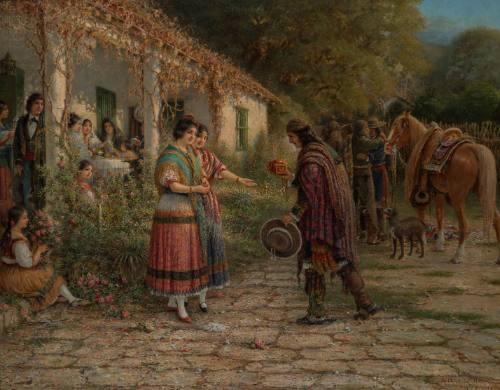
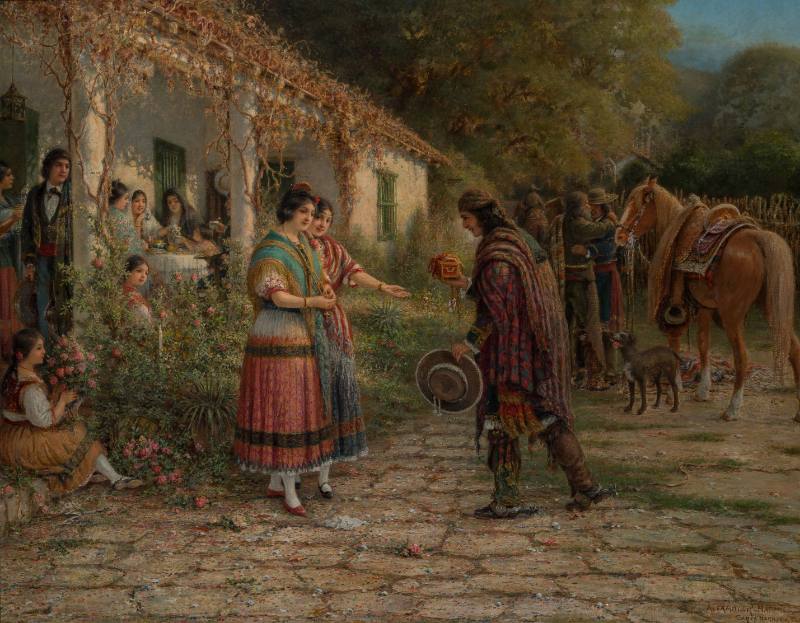
Santa Barbara, CA - The Proposal
Artist
Alexander Francis Harmer
(1856 - 1925)
Datec.1894
MediumOil on canvas
Dimensions28 x 33 in. (71.1 x 83.8 cm)
Framed (brown, wired, not glazed): 31 1/2 x 38 in. (80 x 96.5 cm)
Framed (brown, wired, not glazed): 31 1/2 x 38 in. (80 x 96.5 cm)
ClassificationsPainting
Credit LineGift of the Hilbert Collection
Object number2019.201
DescriptionAlexander Francis Harmer was a pioneering figure in early California art, known for his evocative portrayals of the region’s people, missions and landscapes in the late 19th and early 20th centuries. Trained at the Pennsylvania Academy of the Fine Arts and later settling in Santa Barbara, Harmer became one of the first professional artists to document the cultural tapestry of California during a time of rapid change. His sensitive depictions of Native American and Spanish Californian life have become invaluable visual records of a vanished era.This painting illustrates a key moment from Ramona, the 1884 novel by Helen Hunt Jackson that became one of the most influential works of historical fiction in American literature. Intended as a call to social justice for Native Americans, Ramona also romanticized California’s Spanish and Indigenous past and helped shape the mythos of the region for generations. In The Proposal, Harmer portrays the tender, hopeful moment when the hero, Alessandro, a Luiseño Indian man, offers Ramona his proposal, symbolizing his devotion and the beginning of their ill-fated love story.
Their love faces strong opposition from the dominant white and Spanish-Californian societies around them, and they suffer injustice, displacement and ultimately tragedy. Like Shakespeare’s young lovers Romeo and Juliet, Ramona and Alessandro are caught in a web of prejudice, societal expectation and historical forces beyond their control.
But while Romeo and Juliet is a personal tragedy shaped by family feuds, Ramona was meant as a social critique. Jackson wrote it to raise awareness about the mistreatment of Native Americans in California following the U.S. takeover. So while the love story is central, it serves a larger purpose: aiming to inspire empathy and reform. The painting speaks to the novel’s enduring legacy and its power to inspire both empathy and idealized visions of California’s multicultural history. Today the Ramona story is still enjoyed by all ages in the annual Ramona Outdoor Play, popularly referred to as the Ramona Pageant, which has been staged in Hemet, Calif. since 1923.
On View
Not on viewCollections