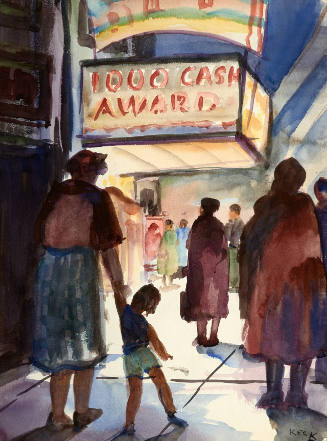
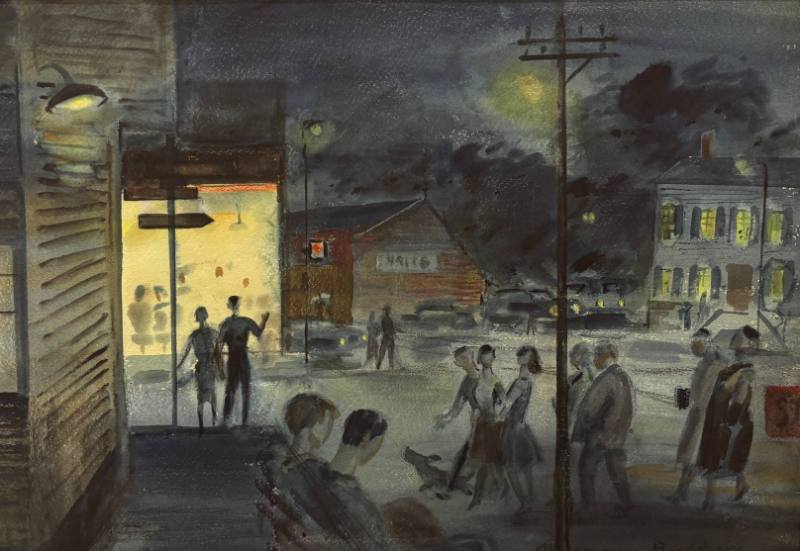
Saturday Night in Fresno
Artist
Alexandra Bradshaw
(1888 - 1981)
Date1940
MediumWatercolor on paper
Dimensions15 x 21 in. (38.1 x 53.3 cm)
Framed (Frame is gold, wired, glazed): 23 x 29 x 1 1/2 in. (58.4 x 73.7 x 3.8 cm)
Framed (Frame is gold, wired, glazed): 23 x 29 x 1 1/2 in. (58.4 x 73.7 x 3.8 cm)
ClassificationsPainting
Credit LineThe Sally and David Martin Collection
Object number2026.017
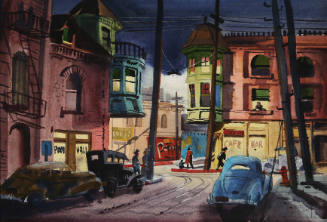
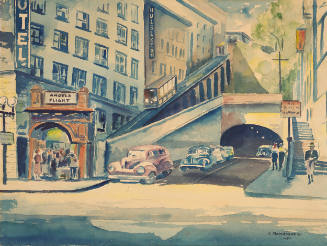
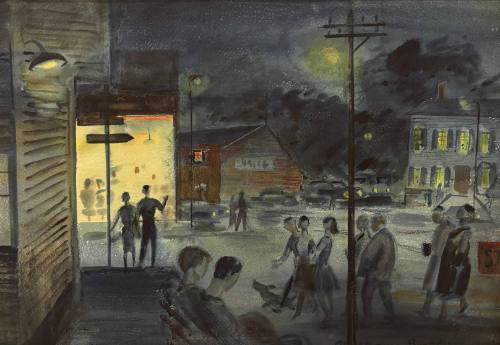
DescriptionWhen this narrative California Style watercolor was produced, Alexandra Bradshaw was head of the Fresno State College Fine Arts Department (1922-1948) and was primarily working in the watercolor medium. When not teaching, she lived in her second home in South Laguna. She was a well-respected artist and an active member of art associations in both Laguna Beach and Fresno, and she also exhibited nationally in museums, as a member of top watercolor associations. During that era, Fresno was a center for agricultural distribution. It was surrounded by small farm-based communities where vast acres of land were planted with grapes for raisins and wine, cotton, tree fruits and nut crops. Dancing to live music or visiting took place in community buildings that were specially constructed for social gatherings. Farming is hard work, so on Friday and Saturday nights these events were something the people looked forward to. Because the populations of these rural areas weren’t large enough to support larger commercial entertainment options, these social events were pretty much it – unless one chose to travel to the few larger cities in the county.
Bradshaw was a California contributor to the larger American Scene Painting movement. This scene painting reflects what night life was like in the rural communities around Fresno. This narrative painting is quite rare and noteworthy in that it visually captures something very few artists chose to depict. Bradshaw does an excellent job of painting the nocturnal lighting and successfully incorporating figurative subject matter in a style consistent with the rest of the imagery. That is not an easy thing to do with transparent watercolors.
– Gordon McClelland, curator