
Frank Romero
born 1941
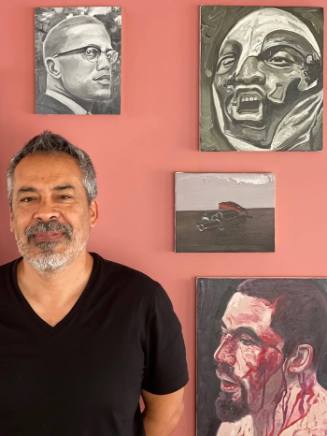
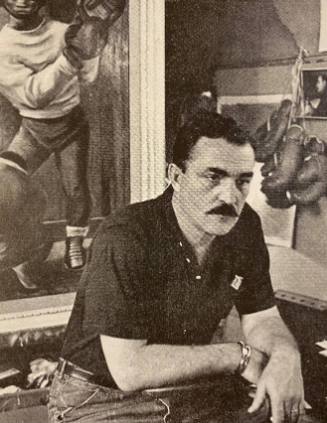
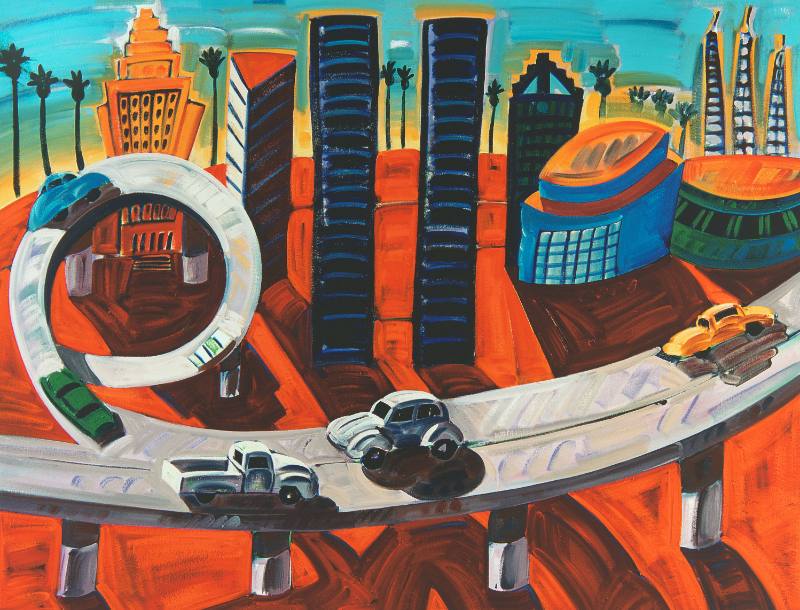
Canonical to the history of Chicano Art, Romero not only helped create the mold that came to define it, but also continues to push its bounds. As a member of the 1970s Chicano art collective Los Four,
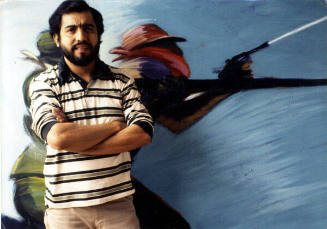
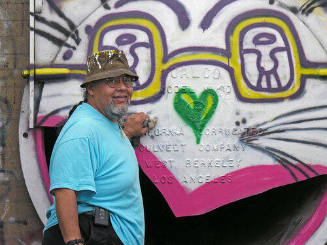
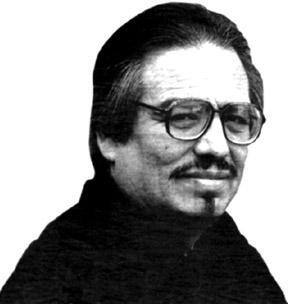
Romero and fellow artists Carlos Almaraz, Beto de la Rocha, and Gilbert "Magu" Luján helped define and promote Mexican American awareness through their individual and collaborative artworks, murals, publications, and exhibitions. Los Four9s historic 1974 exhibition at the Los Angeles County Museum of Art (LACMA) was the country's first presentation of Chicano art at a major art institution. This watershed exhibition, and its accompanying programming, challenged how we define Chicano art and fine art more broadly - a postcolonial intervention that exposed exclusionary legacies and opened doors for future generations of artists. Since then, Romero has exhibited extensively in the United States, Europe, and Japan, with his work being included in notable exhibitions such as Our America: The Latino Presence in American Art, organized by the Smithsonian American Art Museum, Washington, D.C.; Chicano Art: Resistance and Affirmation, 1965-1985, organized by the Wight Art Gallery at the University of California, Los Angeles and the CARA National Advisory Committee, Los Angeles, CA; and Hispanic Art in the United States: Thirty Contemporary Painters and Sculptors, organized by the Museum of Fine Arts Houston, Houston, TX, and the Corcoran Gallery, Washington, D.C. Romero's works are included in such prominent collections as the Smithsonian American Art Museum,
Washington, D.C.; Whitney Museum of American Art, New York, NY; Museum of Modern Art Library,
New York, NY; The Los Angeles County Museum of Art (LACMA), Los Angeles, CA; The Cheech Marin
Center for Chicano Art & Culture, Riverside, CA; The Crocker Art Museum, Sacramento, CA; Museum
of Contemporary Art San Diego, San Diego, CA; The Carnegie Art Museum, Oxnard, CA; the Blanton
Museum of Art, Austin, TX; the McNay Art Museum, San Antonio, TX, among others.
Person TypeIndividual